The Practical Power Of Listening To Yourself (Ultimate Guide)
“Listening to yourself isn’t airy-fairy. It’s vital to your success. It seems obvious, but most of us don’t do it.“
What does it mean to “listen to yourself”
Listening to yourself, sometimes called listening within, means tuning in to how you are feeling, what you are thinking, and what you need, in real time.
That sounds obvious. In practice, most people are out of touch with themselves far more than they realise.
We live in a world designed to pull attention outward. Devices interrupt us on their terms. Work spills into everything. Advice, opinions, and expectations are constant. Against that backdrop, listening to yourself takes intention.
And yet it is deeply practical. It is not vague or indulgent. Listening to yourself is central to making good decisions, trusting yourself, and living in a way that actually fits.
In this article, find out how and why to go beyond the every day “surface” thinking about what to have for lunch, or what to post on LinkedIn, to elicit powerful insights and personal truths. And uncover blocks to success.
Learn how your inner critic has more wisdom for you than you might think. And discover the “4 Levels of Listening Within”.
Why listening to yourself matters
When people say they feel adrift, stuck, or unsure what they want, what is missing is often not intelligence or motivation, but a reliable way of consulting their own inner experience – their wise knowing about what’s right for them. Without that, decision-making becomes guesswork. You choose based on habit, pressure, or what looks sensible on paper, rather than what is actually right for you.
Self-awareness is a process not a destination.
This matters because values are not abstract ideas you figure out once and then live by forever. They are living signals. You may not always be able to name them, but at some level you know when something is off. When the way you are living is out of alignment with what matters to you now, dissatisfaction builds quietly.
Listening to yourself is how you notice that mismatch early, rather than years later.
Ignoring your inner experience has consequences. Emotions surface sideways. Stress accumulates. You may act impulsively, overwork, or get caught in loops of self-criticism without realising what is happening. Many people only pay attention when the body or psyche forces the issue.
So why is listening within so hard?
For some, it was never encouraged. If you grew up in an environment where your feelings, preferences, or opinions were dismissed, this skill may not have developed. For others, an active inner critic makes listening to themselves feel unpleasant or unsafe.
For all of us, the outer noise is relentless. Cultural shoulds. Advertising that tells us what to want and who to be. “Always-on” work that eats into time and attention. Endless information, opinion, and instruction. No wonder that our inner signal struggles to be heard above the noise.
The signal is there whether we listen or not. Thoughts run in the background. The body sends signs and symptoms. But this inner activity is often treated like mental wallpaper.
Or we listen only to argue with ourselves, override what we feel, or push through. Rarely do we listen in order to understand, despite this being a tenet of effective listening to others..
To improve anything, you need to know where you are starting from. Over time, I have come to see that there are different depths at which we can listen to ourselves.
I describe these as four levels of listening within.

Level 1: Basic needs
Listening to yourself can be as basic as noticing when you’re hungry, or tired, or happy. (This is what I think of as Level 1 Listening.) We all know we should listen when our body is telling us we’re in need of a break, or that we’re taking on too much. But quite often, we don’t.
When we don’t pay attention to what our body is saying, it will shout louder and louder until we do listen. Even if that means making us ill.
At Level 1 we take a quick sounding on every day concerns. For example: “What do I want for dinner?”, “What needs to go in this report?”, “Do I want to go to this event?”.
Much of what comes up in level 1 listening is internal chatter, and is influenced by what’s going on around us. For example, what other people say or do, what we read in the news, the song we heard on the radio, the programme we just watched.
Moving deeper, to level 2, involves tuning in to yourself a bit more, and beginning to notice patterns…
Level 2: Noticing Patterns
Gut feelings and hunches
“Gut feelings” come to us unexpectedly in relation to a situation or a person. Have you ever met someone new and got a squirmy feeling between your shoulder blades about them? You, straight away, don’t trust them although you might not be able to say why.
I think of this as Level 2 Listening: noticing that something happens in your body in relation to something or someone one else. You notice that a pattern is emerging.
This is exactly what hunches or intuitions are – awareness of a pattern, which indicates for example: … that deal isn’t going well… that employee is in need of support… that person is up to something…
This also applies to awareness of our own patterns of thinking and self-talk, of which the Inner Critic is a special case.
Inner Critic patterns
As we’ve already mentioned, inner voices can be difficult, critical, and undermining. The inner critic is a pattern of this type of self-talk. When you’re listening at level 2, you’re noticing that this self-critical pattern has appeared (as opposed to just being caught in it and reacting from that place).
And the inner critic does, in fact, tend to talk in patterns, rehashing the same stuff over and over.
Some liken this to “head-tape” that they can’t turn off. Understandably, without support, you can get stuck here if it feels too unpleasant, or too scary, to go further.
Levels 1 & 2 are a bit like push notifications…
Our inner voice talks, our body nudges us, “something” is there.
How deeply we attend to these messages, and how judgmental about them or judged by them we’re feeling, defines whether we go to the next level of listening.
Level 2 Listening is about pattern awareness: noticing there’s something significant showing up.
But what can you do with that?
Level 3: Inner Relationship
Towards the end of writing this article I hit a wall. I began and deleted a dozen sentences. I started filing a rough bit on one of my nails. Then filing all my nails. I wondered what was going on in the world… I reached for the mouse to click over to Facebook…
Beyond those outward signs, there was an inner sense of something…. something sticky and muffling, like a blanket of fog.
I realised that here was something that needed listening to. So I went through the process I use to listen to myself:
I got grounded. I invited “the something in me that feels muffled and foggy” to come forward. And shifted into what I call “open-field listening”. Straight away an image came. An image from “The Lord of the Rings” of the elderly Bilbo Baggins restlessly walking about his room. That probably won’t mean much to you. but it meant tons to me!
You see, at this point in the story Frodo has gone off to try to destroy the ring. Bilbo is at home trying to write his memoirs, while the “real action” is going on elsewhere.
And then came the message “This isn’t real work and no one is ever going to read this anyway“.
Wow! No wonder I couldn’t finish writing it, if something in me thought it wasn’t “real work” and was worried no one would read it.
(to be continued…)
This is an example of going beyond level 2: noticing patterns, to level 3: deliberately interacting with them. When you do this, you can access the wisdom inherent in them.
This deliberately getting into relationship with is characteristic of level 3 listening.
Some key principles to level 3 listening:
- Believing that however the “something in you” shows up, its intention is positive
- Listening is in order to understand, NOT in order to evaluate, change, fix, argue, or reassure.
- Knowing that what you resist (through arguing, pushing down, reassuring etc) persists.
- It is possible to acknowledge that what it believes is true for it, but not necessarily the whole truth.
- Acknowledging what is, allows it to change
An inner conversation
Acknowledging is the next step
When I acknowledged the message: “Ahhhh – you think this isn’t real work. You’re worried no one will ever read it”, I felt a definite shift. A relaxation. I gave it some empathy: “No wonder you don’t want to finish it. I understand now.”
Then a sense of what it didn’t want: “You don’t want me to be disappointed?”
“Ahhh ok I hear that.” A feeling of fresh air. The fog lifted and I was able to continue writing.
A crucial difference at level 3 is not just listening, but also responding empathically. So it becomes more of a conversation than a series of notifications. How easy or hard it is to interact in a way that produces helpful shifts – like my fog lifting – depends on:
- Whether you’ve learned an effective structure for facilitating the conversation
- How much support you have – it’s far easier to have a useful conversation (especially with difficult inner voices) when you are supported by a guide or companion
- The nature of the inner voice – is it helpful and kind, or critical and judging?
- How you feel about the kinds of messages or feelings that come up.
So what if you feel bad, sad, or frustrated by what comes up?
Is your inner voice always right? What if you don’t like what it says?

There’s no doubt that if your head is full of critical voices telling you you’re no good, or that you’ll never amount to anything, it wouldn’t be surprising if you didn’t want to listen to it.
Many, many people will tell you that if your inner voice is negative, or keeps beating you up and telling you “you’re no good”, then you should contradict it. Push it down. Replace it with positive affirmations.
A different approach
Your inner voice is always right, but ONLY about the part of the puzzle that it has.
It’s telling you what it knows. But it doesn’t know everything.
And what it says shouldn’t be taken at face value, because, although your inner critic might seem powerful and mean, it’s actually scared and out of its depth.
When it says:
- “You’re rubbish at this“, what it means is “I’m worried that you might be rubbish at this.“
- “You’ll never get anywhere“, what it means is “I’m scared that you’ll never get anywhere.“
- “why bother – no-one will ever read this“, what it meant was, “I’m worried no one will ever read this, and I don’t want you to be disappointed.“
Take a moment to feel this shift.
This is a crucially different mindset with which to listen to your inner critic.
Notice how it changes not just how you listen, but what you’re listening for.
Now, instead of listening to argue with it, or to shut it up, you’re listening for nuance, sense, how it might be feeling.
This is an example of listening for more than just what’s on the surface.
Imagine what would happen if you could have this kind of beneficial, loving relationship with yourself all the time. That’s Level 4…
You’re reading “The Practical Power of Listening to Yourself – Ultimate Guide” Read this article from the beginning

Level 4: Living in Flow
If level 3 is going beyond listening to yourself to deliberately moving into relationship with yourself, then level 4 is when this becomes a way of being.
At level 3 blocks to action, and the things that keep us stuck can be accessed, understood, and shifted.
At level 4, this is an on-going living process of living in harmony with yourself. Decisions and actions flow because you’re in alignment. Thoughts, feelings, and emotions are experienced and regulated moment by moment.
Doesn’t this sound lovely? Of course, for most of us, most of the time, this isn’t where we’re at.
Yet nearly everyone will have had the experience of being in “flow”. Calm, “in the zone”, open to whatever is arising, responding from a sense of a larger, more connected Self, or apparently divine presence.
The doorway to Level 4 of listening within is to make listening to yourself, and being in relationship with yourself, into a regular practice.
There are a variety of approaches to this. The one I teach is Experiential Focusing (a.k.a. “felt-sensing”) and you can read more about that here: What is Experiential Focusing or “Felt Sensing”?
Here are some other ways you can improve your self-listening skills…
Some of the ways you can improve your self-listening skills
Most active listening courses emphasise “listening to understand” over “listening to respond”. Above I suggested that attending to your inner critic in order to understand it, was more useful than listening in order to tell it that it’s wrong.
Imagine what would happen if you applied active listening skills to yourself. This kind of listening to yourself is at the heart of most change processes, from psychotherapy to coaching. My main job, as a coach, is to help you listen to yourself more effectively.
Working with a professional listener is always going to help.
Other ideas for improving your ability to listen within:
- Keep a journal. Writing your thoughts, feelings and idea down helps you listen better to yourself, partly because the page is completely non-judgemental, partly because getting it down on paper can be cathartic. Plus it helps you notice patterns that might slip past you otherwise.
- Have you ever been stuck trying to write something and found that putting your brain in “idle” by going for a walk or taking a shower, brings all sorts of new ideas? (This has been a 4-walk article for me!)
- “Active reading”, especially self-help books – make sure you do the exercises they suggest, and stop every so often and ask yourself “how might that apply in my life?” Some suggestions in the image below
- Take an active listening class – then try applying the skills you learn on yourself.
- The biggest thing is to set aside time for yourself – uninterrupted by children, or social scrolling, or chit-chat.
- Learn Experiential Focusing… Listening within is always a conversation between your wise body, your wild heart, and your smart brain. Experiential focusing IS the facilitation of this conversation in a way that generates insight, and produces shifts in how you experience and hold your problems.

It’s not just a voice
Bear in mind that inner wisdom doesn’t always come as a “voice”. It can be a physical sensation (a headache, nausea, tension, or relaxing), an atmosphere or an “energy”.
It can show up in metaphors – our bodymind speaks to us in metaphorical terms a lot, for example in dreams. And also when we say things like “I feel like I’m walking through treacle” or “She was spitting nails.”
In fact it’s arguable that more inner communication comes in these forms, than as actual voices.
So when we talk about listening to ourselves, especially at the higher levels, we’re really talking about sensing into ourselves, rather than necessarily listening to an actual voice in our heads.

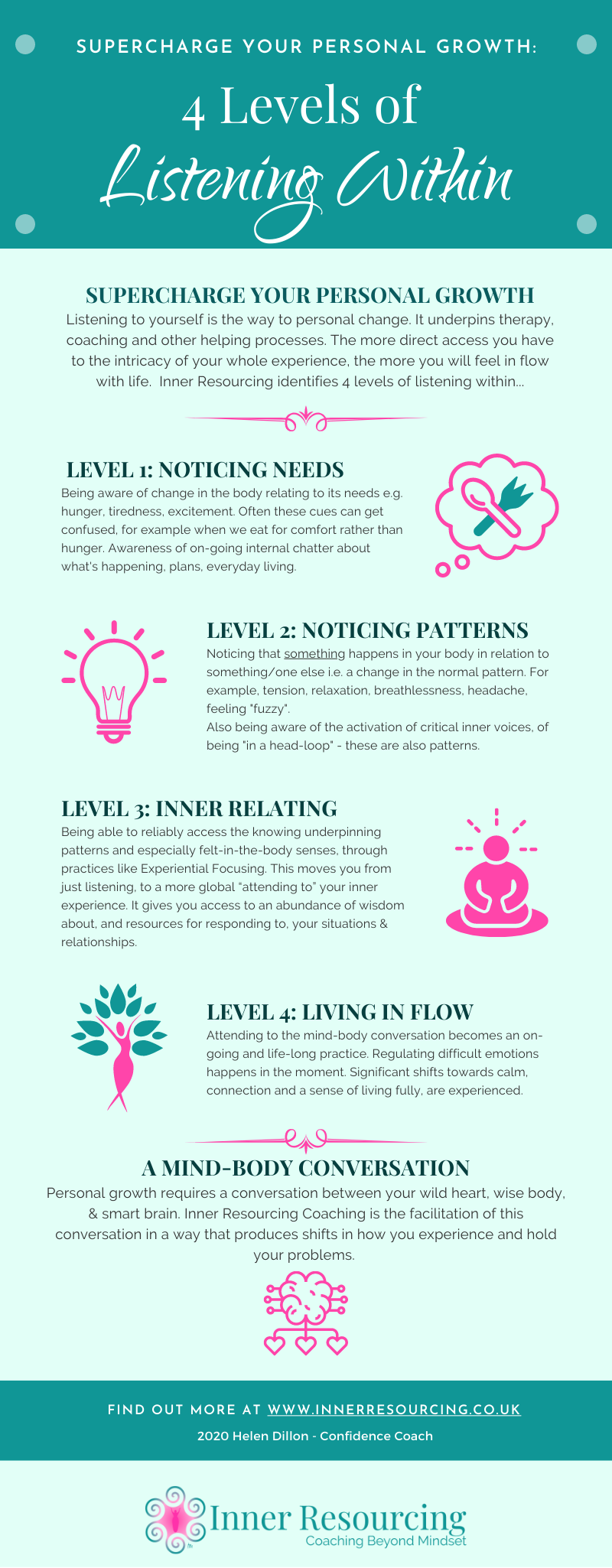
Supercharge your listening, supercharge your growth: a summary of the 4 levels of self-listening
Level 1 Receiving notifications.
Everyday messages about your body’s health and vital systems – like hunger, or sleepiness, as well as more global senses about how tired we are, how stressed we are, or how happy we are. Depending on how responsive we are to our own needs, the body may be shouting at us by the time we attend to it. Everyday cognitive decision-making.
Level 2 Noticing patterns
Either in your body i.e. that something happens in your body in relation to something/one else (outwith it’s normal living cycles) For example,
- When your brain feels “fuzzy” and sleepy, even though it’s mid-morning and you’ve had a good night’s rest.
- That squirmy feeling between your shoulder blades every time you interact with a certain person.
- When a particular task seems to have an invisible force field round it and you just. can’t. get. to. it.
Also noticing patterns of self-talk, like the Inner Critic.
Level 3 Inner Relating
Being able to reliably access the knowing underpinning these felt/heard in the body senses. You notice there’s “something there” and you are able to tune in more closely. You focus your attention, in a friendly, open, and curious way. This moves you from just listening, to a more globalised “attending to” your inner experience. You are in relationship. This gives you access to an abundance of wisdom about, and resources for responding to, your situations & relationships.
Level 4 Living in Flow
When this kind of attending to the body and your inner experience becomes a regular practice – shifting long held blocks and nurturing growth. Living in this way in an ongoing fashion i.e. growthful inner conversations become a way of being.
Pingback:Is it imposter syndrome or are you just new here? ⋆ Inner Resourcing