Becoming Yourself: Staying human in a brutal world
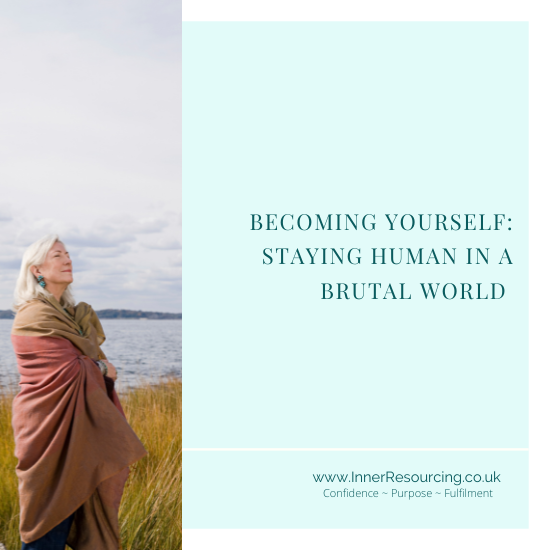
The world seems to get darker by the day
I don’t mean that in an abstract, hand-wringing way. I mean violence, cruelty, indifference, systems that reward cruelty and domination, and grind people down quietly and efficiently.
Many of us have (and have always had) the privilege to be able to switch off from a lot of this. But pretending it’s not happening doesn’t change what our bodies know and our communities carry.
This is a huge dilemma for all caring, thinking people: How to stay informed and work towards something better for everyone, while staying sane. Without plunging into despair and a constantly dis-regulated nervous system.
Because it’s in the headlines, yes. But it’s also in our bodies. In the background tension many of us live with. In the toll it takes on those trying to stay human – creative, loving, intelligent, embodied, connected – while being repeatedly exposed to other people’s cruelty.
What doesn’t help is being told to stay positive, focus on what you can control, be resilient, keep producing, keep coping. As if this is all just a mindset problem, rather than a moral and structural one. As if the appropriate response to a brutal world is personal optimisation.
For women, none of this lands neutrally
We live in a world that depends on women’s care, steadiness, emotional labour and moral backbone, while systematically devaluing us for it. And for older women, the message is clearer still. Be quieter. Be grateful. Don’t take up space. Don’t expect much. Don’t imagine you still matter.
This is not imagined.
You become less visible just as you become more yourself. Less rewarded just as you have more to offer.
More free-thinking, more discerning, more clear, and increasingly treated as expendable in the eyes of the culture.
This is not a coincidence
A culture organised around extraction and compliance has little use for women who are no longer trying to please, prove or perform. Women who are clearer, more discerning, less willing to contort themselves are harder to manage and harder to exploit.
Visibility drops precisely as independence grows. This is how the system maintains itself.
So when I talk about women coming together, I’m not talking about cheering ourselves up, or empowerment slogans, or fixing ourselves so we can better tolerate the intolerable.
I’m talking about something simpler and more serious.
Spaces where women listen to one another without correcting, diagnosing or reframing. Interactions where you don’t have to perform optimism or competence. Rooms where your experience is taken seriously, not minimised or rushed past.
That kind of listening is not soft. It is a refusal to be gaslit in a culture that benefits from women doubting their own perceptions.
Self-appreciation instead of never-enough-ness
So here I am coming at the structures of empire: patriarchy, racism, misogyny, extraction, with seemingly small things.
- Self-appreciation instead of never-enough-ness
- Giving more weight to how life is living me from the inside as opposed to how consumerism wants to use me from the outside
- Self-compassion as an antidote to self-criticism and self-abandonment
It isn’t in the interests of capitalists, tech companies, or grind culture for us to be rested, self-aware, with a clear mind, and a way to pause everything and think about it all, for ourselves.
It is, however, in OUR interests.
This is where Focusing can make such a difference in our lives. Focusing IS as Mary Hendriks says: a revolutionary pause. And it provides ways to step out of all of that noise and distraction and think with our whole selves.

“When a person can pause and go inside and say what is “my sense” of this situation, that is the thing that makes them less vulnerable to oppression.”
MAry Hendriks: “Focusing as a Force for Peace: The Revolutionary Pause”
Appreciation is NOT gratitude
Self-appreciation, as I understand it, isn’t about confidence or affirmations.
It is also – emphatically – not gratitude.
Women are so often expected to be grateful to something or someone. Grateful for the chance. Grateful to still be included. Grateful for what hasn’t yet been taken away. Grateful to be at the table. Grateful you’ve got a job. Grateful “it wasn’t worse”.
That kind of gratitude isn’t neutral. It creates obligation. It keeps you small.
Self-appreciation is different. It doesn’t flow upwards. It doesn’t put you in debt. It’s an internal reckoning with what you’ve lived, what you know, what you’ve carried.
In a world that benefits from women being grateful for scraps, self-appreciation is quietly subversive. It’s about knowing what you’ve carried. Acknowledging what it’s cost. Recognising your skills, your limits, your wisdom, without apology or inflation.
It’s also the basis for self-leadership and authorship of your own life
In a culture that devalues women, that kind of self-relationship is an act of resistance.
Staying Human, Ethically, Truthfully
The deeper question underneath all of this is not “How do I stay positive?” It’s “How do I stay human?”
How do we live well, ethically, truthfully, in a world that doesn’t particularly care about women’s lives, especially as we age? (And within systems that are, often, acting against the interests of both our species and our planet.)
There is no tidy answer to that.
But I do know that doing it alone is not the answer.
Coming together to listen (to ourselves and each other), to witness with compassion, to take ourselves and one another seriously isn’t an escape from the world. It’s one of the ways we stay intact, without disappearing.
That’s the work I care about. And it feels more necessary than ever.