
SMALL GROUP COURSE
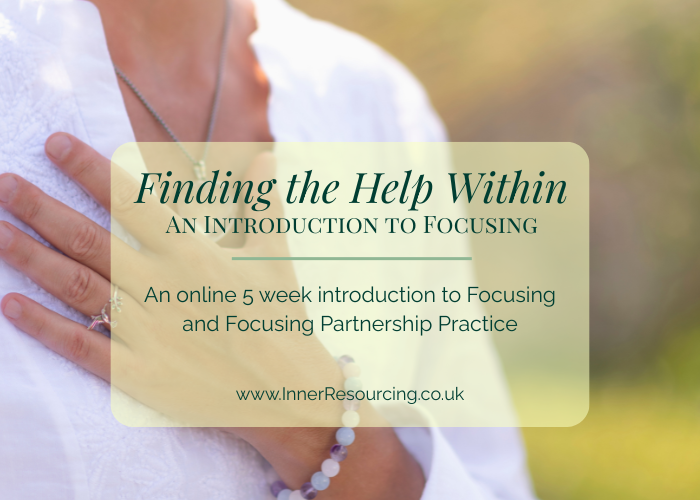
Finding the Help Within
A practical introduction to Experiential Focusing
Next online 5 week (BFA Level 1) course begins 2nd June 2026
Focusing: when thinking things through isn’t enough
You can think something through carefully, talk it over, reflect on it from every angle, and still not feel any clearer about it.
And then there are moments when something shifts.
A decision lands. A hunch opens into an aha moment. And you feel it in your body – not only in how you think about it.
That kind of clarity isn’t accidental
There is a way to access it, reliably, when it matters.
This is where Experiential Focusing comes in. Experiential Focusing is a simple, learnable process for tuning into a subtle, bodily sense (often called a “felt sense”), where clarity and meaning form as you pay attention.
For some people, it begins as something to reach for when life feels stuck or unclear. For many, it becomes something more: a regular practice of checking in with themselves. It becomes a way of approaching decisions with more depth.
What you’ll learn in this Introduction to Focusing course
You’ll learn to work with your own felt sense experience in real time and to support someone else in doing the same. (More details below)
You may already recognise this: Being with someone who listens in a way that helps you hear yourself more clearly, without advice or direction. If you work with others, you may already have some sense of this.
Focusing: a practice you can return to
Focusing is also a recognised contemplative practice.
One you can return to throughout your life, not just when something needs resolving. Many people who learn it continue for years, not because something is always wrong, but because checking in with themselves in this way becomes a meaningful part of how they live.
Learn to trust what you know, and act from this place of clarity and wisdom.
Introducing Experiential Focusing…
Experiential Focusing is a self-facilitated, mind-body process that involves getting in touch with something called the “felt sense”. This is an emergent bodily-held sense of the whole of a situation, which carries more information than thoughts or emotions alone.
A felt sense isn’t an emotion, and it isn’t just physical sensation. It’s something more like the whole felt meaning of a situation in you at a given moment. Often unclear at first, but definite enough that you can sense when you’re with it.
Focusing teaches you how to stay with that sense, without trying to fix or interpret it too quickly, until it begins to shift, form, or clarify on its own terms.
Focusing in a Partnership

You can Focus alone, or with a trained peer listener, often called a Companion. A Companion supports your process by offering a particular kind of non-directive attention. Their role is to help you, the Focuser, stay in contact with your own process as it unfolds. In this course, from the beginning, you’ll practise in pairs, taking turns as both Focuser and Companion.
This peer partnership format is regarded as a key benefit of Focusing, both while learning and beyond. It not only helps you develop the skills, it also makes it much easier to continue the practice beyond the course.
A Unique Relationship
Many long-term Focusers maintain a regular partnership for years, accompanying each other through significant periods of their lives. It becomes a relationship in its own right, perhaps the only one like it in your life. One where both people know how to be present without agenda. Learning the companion role isn’t just a training exercise; it’s the beginning of something that can last.
Whether you come to Focusing because something needs attention, or simply because you want to live with more depth and awareness of yourself, the practice grows with you.
If you’re ready to join my 5 week course for beginners, starting in June 26:
Who this course is for
This course is for you if you’re already curious about your inner experience and want a more direct, embodied way of working with it.
Tends to suit people who:
- are reflective or already used to some form of inner work, but want something more direct and experiential
- have noticed that thinking and talking only take them so far, and are interested in a more embodied way of working
- are drawn to somatic, mindfulness, or relational approaches, and want something more structured and precise
- work with others in a helping or listening role and/or have heard about Focusing during their training and are curious to learn more
- want to develop their listening skills, beyond standard “active listening” approaches
- are curious about how attention, body sense, and meaning come together in real time
This course is beginner level and open to all. You don’t need any previous experience of Focusing.
What matters more is a willingness to engage directly with your own experience.
“Working with Helen was truly a gift. She has an incredible teaching style that is marked by a collaborative approach. Since working with Helen, I have used my Focusing skills in every area of my life and discovered profound insights and sense of calm.
No matter your journey, I cannot recommend Helen enough!“
In this introductory Focusing course, you’ll learn
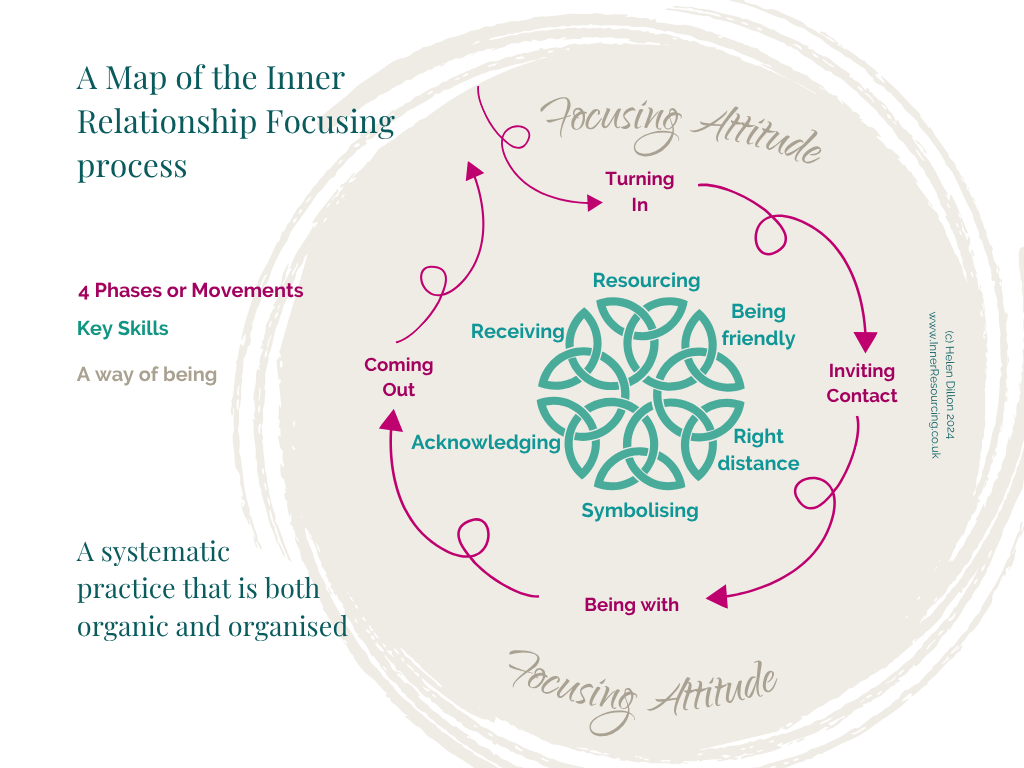
5 Foundational Focusing Skills
These are core skills of Focusing. How you learn to relate to what’s happening inside you in a more direct, steady, and responsive way.
- Being friendly with what arises: Maintaining an open, friendly attitude towards your inner experience isn’t always so easy, especially when the inner critic is about. Learn how to shift into a more supportive way of relating to what you find inside. And what to do when that’s hard.
- Resourcing yourself: Focusing can bring up strong feelings. Practice embodied ways to feel supported and resourced so you can stay with experience without becoming overwhelmed by it. Gain strategies for in-the-moment self-support and regulation.
- Finding a right distance: Sometimes you may feel overwhelmed by your inner experience, and other times it may feel hard to contact anything at all. Learn simple ways of finding a right distance so you can initiate and maintain right-relationship with what’s there.
- Symbolising/Resonating: Focusing involves the use of metaphor to explore what is at first only felt inside. Learn how to check that the words, images, or meanings that arise fit “just right”, and how to stay with them as they shift. This is a form of precise inner listening and self-empathy.
- Receiving: When you receive your inner truth, something shifts — in how you understand things and how you carry them. Learn how to recognise and reinforce these moments of change so they become more stable and usable in daily life.
Companioning/Partnership skills (working with another person)
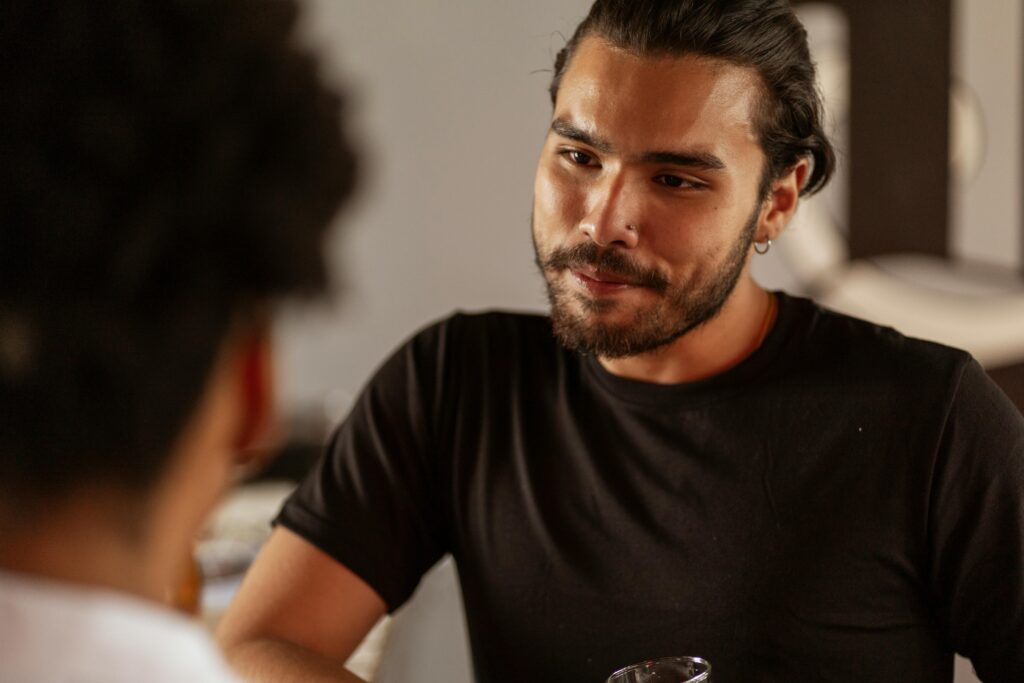
Alongside learning to Focus for yourself, you’ll also learn how to support someone else as they Focus. And experience what it’s like to be held in that same kind of attention yourself. This is a distinct but related skillset, learned through practice in pairs. These highly tuned listening skills will help you in every area of your life.
- Appreciative listening: Learn how to listen in a way that supports another person’s process without interpreting, advising, or steering it.
- Staying out of the way of the process: Notice how easy it is (even with “active listening”) to interrupt or shape someone else’s inner process. Learn how to avoid doing that (with compassion for yourself) while still being fully present.
- Supporting attention without leading it: Learn how to stay alongside someone’s unfolding experience without taking it over or trying to move it forward.
Overarching principles
These are the underlying capacities that shape both Focusing and Companioning.
- The Focusing attitude: the quality of attention that makes the whole process possible
- Self-in-Presence: how to step out of inner arguments and familiar patterns to get insight and access resources
- Sensing freshly: learning to meet what arises without relying on assumptions or familiar stories
This set of simple but precise skills together change how you relate to your own inner experience. And they’re key to how you are with other people when they’re exploring theirs.
How the Intro to Focusing course works
Five weekly classes are live on Zoom, in a small group of between four and eight people. Each class lasts 2 hours and 15 minutes, with breaks.
Classes include short teaching input, demonstration, and group discussion. There will also be plenty of guided practice in pairs, where you’ll try both Focusing and Companioning in real time, with support throughout. You’ll be learning by doing from the very first session.
Between sessions, you’re encouraged to practise once a week with a partner from the group. You’ll get the chance to work with different people, both in class and between sessions.
Each week you’ll also receive simple written materials to support your learning, plus a journal with prompts for personal reflection.
Attendance and certification
Sessions are recorded for catch-up if needed, though attending live is strongly recommended. Breakout rooms are not recorded.
Live attendance and one between-class practice per week are both required for the Level 1 Attendance Certificate, validated by the British Focusing Association. This five-week course (five two-hour classes plus five practice sessions) is Level 1 of the Focusing Skills Certificate.
The BFA Focusing Skills Certificate runs across five levels. Completing this Level 1 Introduction to Focusing enables you to continue to Levels 2–5, either with me or with another teacher.
Interested in joining us?
Jump to booking details and FAQ
Next cohort June 2026
Your Facilitator/Course Leader
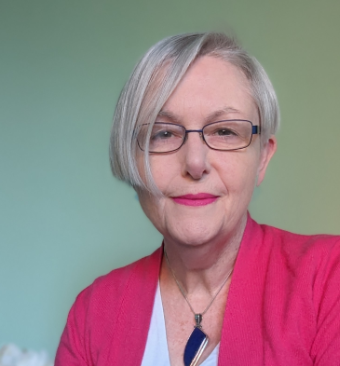
Hi, I’m Helen, your Focusing Facilitator
I first discovered Focusing in 1997 but it wasn’t until 2018 that I decided to train formally and made it an everyday part of my life. In 2021 I became a British Focusing Association certified Focusing Practitioner and a Certified Focusing Professional with the International Focusing Institute. I attend many CPD workshops and courses. I’m running this course as part of my teacher training certification, and am mentored and supported by Peter Gill (Author of “The Way of Curiosity” and Focusing Institute Coordinator) and Fiona Parr (BFA Focusing Mentor, psychotherapist and supervisor, and Coordinator of The International Focusing Institute)
But Focusing is about so much more than certifications. I meet regularly with one or other of my Focusing partners for partnership practice. I’ve integrated Focusing into my coaching approach and run a workshops on various aspects of it. I’ve just led a 9-week programme “The Older Women’s Self-Appreciation Society” using practices and principles from both Focusing and Thinking at the Edge (the other process developed by Eugene Gendlin).
Before I made Focusing part of my life, I often felt stuck, confused, or like my life was out of control. Focusing has helped me understand myself better, and since practising it regularly I’ve been able to shift what were some significant blocks in my life.
I now feel much more free to do the things I want to do, and am clearer about where I’m going and what I want, far more often.
I want this freedom and clarity for you too.
Frequently Asked Questions
Do I need any experience of Focusing to join? 
Is this therapy?
Is this only for women?
What if I have to miss a session?
I already do mindfulness/therapy/journalling. How is Focusing different?
What’s the difference between a felt sense and an emotion?
Will I be expected to share personal things with the group?
What do I need to participate online?
I have a question that isn’t answered here.
Booking Now Open:
Not ready to commit? Try a one-off guided session first.
Any questions, or for other payment options, drop me a message below